
Auto Loans
How to compare shorter and longer auto loans
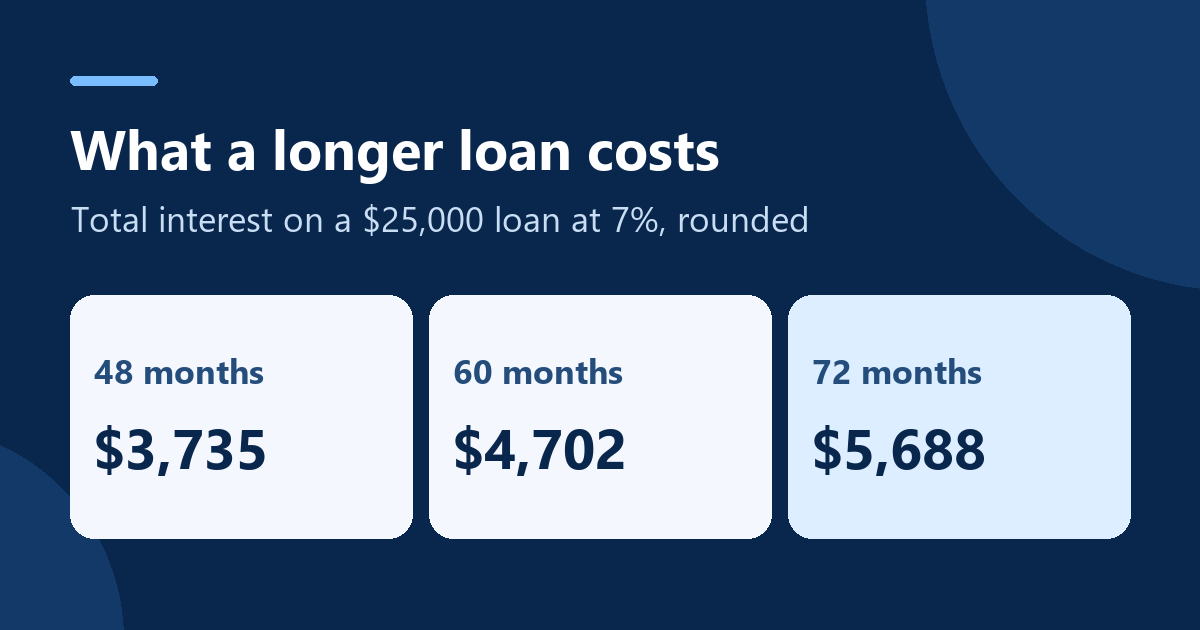
A 72-month auto loan can make the same car look almost $70 a month cheaper than a 60-month loan. That can be useful if the shorter payment is out of reach. But the longer term may also cost more and leave you owing money long after you wanted to replace the car. Compare the amount financed, the term and the total of payments before you decide what the monthly number means.
Start with the same deal on the same car
Get the out-the-door price in writing. It should identify the vehicle, taxes, title and registration fees, dealer charges and anything optional you accepted. Separate that purchase price from the trade-in allowance and any existing loan payoff. For a fair comparison, ask the bank, credit union and dealer to quote the same loan amount and down payment. If the dealer will not give you an itemized price without discussing payments, obtain an outside financing quote and compare again when you have the missing details.
The CFPB's guide to comparing offers explains why the APR, loan term and total cost matter along with the payment. The interest rate determines the interest calculation. APR helps compare the annualized cost, including certain finance charges. A lower APR can still produce a higher total dollar cost if the loan is much longer or the amount financed is larger.
See what a longer term buys you
| Term | Monthly payment | Total interest | Total payments |
|---|---|---|---|
| 48 months | $598.66 | $3,735.49 | $28,735.49 |
| 60 months | $495.03 | $4,701.80 | $29,701.80 |
| 72 months | $426.23 | $5,688.21 | $30,688.21 |
The example assumes a fully amortizing loan, equal monthly periods and no fees or late payments. Totals use unrounded payments. Going from 60 to 72 months reduces the payment by about $68.80, adds one year of payments and increases total interest by $986.41. If a lender also raises the interest rate for the longer term, the difference can be larger. Use the fixed-rate calculator to repeat the comparison with the quotes you actually received.
A longer term also reduces principal more slowly, which can matter if you plan to sell or trade the car before payoff. The resale value and the loan balance move independently. If the car's value drops below the payoff, you need to cover the difference or finance it elsewhere. See our trade-in and negative equity guide before counting on an early trade to exit a long loan.
Compare rebates and promotional financing in total dollars
A manufacturer may offer a cash rebate or a promotional APR with different eligibility rules. Ask the dealer to show the full out-the-door price and total of payments for each option. For a simple hypothetical example, compare a $26,000 loan at 6% for 60 months with a $24,000 loan at 7% for 60 months, all else equal. The first payment is about $502.65 and total payments are $30,159.17. The second payment is about $475.23 and total payments are $28,513.73. The lower rate did not win because the second scenario borrowed $2,000 less. Real offers may also differ in down payment, tax treatment or other charges. Include those differences explicitly.
Dealer-arranged financing can be convenient. If you already have a written preapproval, ask the dealer to beat it using the same principal and term. Ask which lender is funding the contract and whether the price is conditional on using that financing. With a price you can compare independently, you can ask a lender to improve its terms without losing track of what the car costs.
Compare the balance at the date you might sell
Return to the $25,000 example. Immediately after 24 scheduled payments, the modeled balance is about $13,371 on the 48-month loan, $16,032 on the 60-month loan, and $17,799 on the 72-month loan. If you could sell the car for $17,000 at that point, the 60-month example leaves about $968 before selling costs, while the 72-month example requires about $799 to close the gap. The example holds the resale value fixed for comparison. It is not a prediction about depreciation. Use the lender's actual payoff quote before a sale.
Give the monthly payment a separate budget test. Add the insurance premium for the exact vehicle, expected fuel or charging costs, maintenance and taxes or registration that recur. If you will replace the car when the warranty ends, check whether that date is before the last loan payment. If a payment fits only at 72 months and leaves no room for a repair or deductible, the comparison should include a car with a lower out-the-door price. Term length can solve a monthly cash-flow mismatch while leaving the underlying purchase expensive.
Match the contract to the deal sheet
Before signing, read the APR, finance charge, amount financed, number of payments and total of payments on the Truth-in-Lending disclosure. Look for a first payment date you can manage, late-payment terms and any prepayment restriction. Check the itemized contract for optional products. If the payment differs from the last quote, ask whether the term, rate, principal or fees changed. Get a revised copy rather than relying on a verbal explanation you cannot check later.
Write down the payment, total financing cost and projected payoff at the date you might sell. Those three figures let you choose how much flexibility is worth paying for. Keep the signed disclosure and confirm that the amount, due date and lender on the first statement match it.