
Auto Loans
How negative equity affects a trade-in
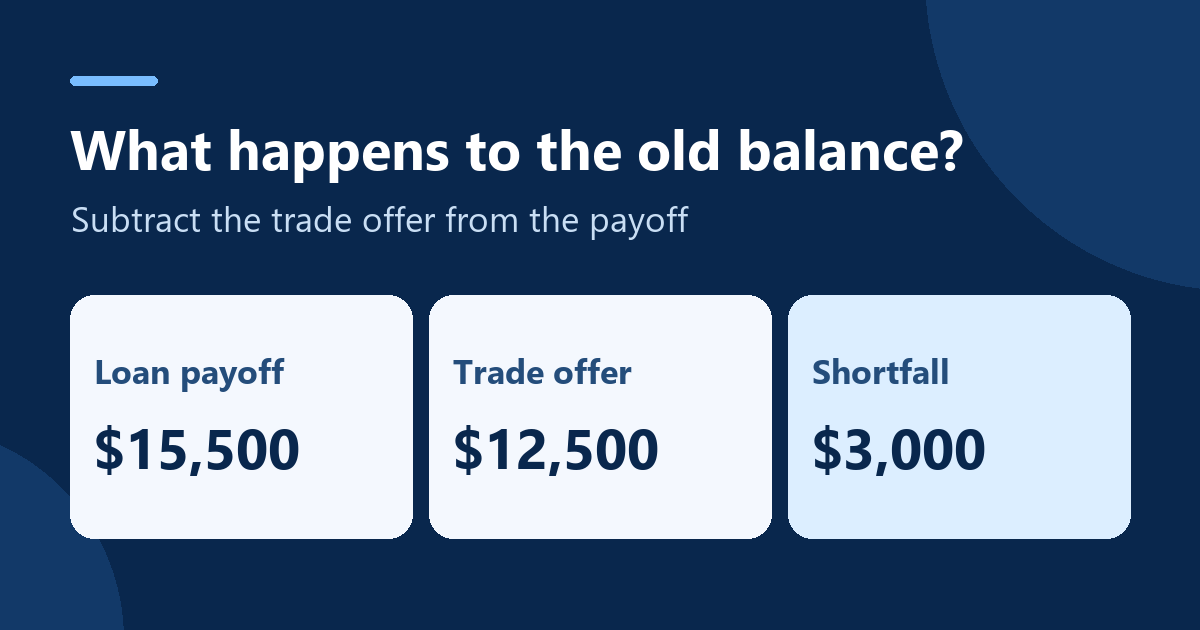
A dealer may say it will pay off the car you are trading in. The question is who ultimately pays the difference if the trade is worth less than the payoff. That money can come from your down payment, from a larger new loan, or from a separate payment you make. Ask for the numbers before negotiating the monthly installment.
Use a payoff quote and a written trade offer
Equity is the vehicle's value minus the amount required to pay off its loan. To estimate it, get a written trade valuation and ask your current lender for the payoff amount for the expected closing date. Your app's loan balance may differ from the payoff because of interest accruing through that date or another charge under the contract. If the quote expires before the dealer expects to close, request an updated figure. The CFPB recommends checking both your payoff and trade value before deciding when to replace a financed car.
If the trade offer is $12,500 and the payoff is $15,500, your negative equity is $3,000. If the figures were reversed, your positive equity would be $3,000 and might reduce the new amount financed. Do not subtract the trade allowance alone while forgetting the old loan. Ask the dealer to list the gross trade, payoff and net equity on separate lines. Compare trade offers on their own, since a higher trade number can be offset by a higher price on the replacement vehicle.
Price the rollover and the alternatives
| How the $3,000 is handled | New principal | Monthly payment | Total loan payments |
|---|---|---|---|
| Pay the shortfall separately | $25,000 | $495.03 | $29,701.80 |
| Roll the full shortfall into the new loan | $28,000 | $554.43 | $33,266.01 |
Both examples assume 60 equal monthly payments, 7% fixed annual interest, no other fees, and no change in the replacement-car deal. Paying separately requires $3,000 in cash up front. Rolling it in increases the monthly payment by about $59.40 and the loan payments over time by about $3,564.22, of which about $564.22 is interest on the old debt. Totals use unrounded payments. In real offers, a larger loan relative to the car's value may also change the rate or what the lender will finance.
The CFPB's loan-to-value explanation divides the amount borrowed by the vehicle's value. If the lender values the replacement car at $25,000, borrowing $28,000 would produce a 112% loan-to-value ratio in this example. A future sale or trade may still leave a gap even after you have made several payments. A longer term typically reduces principal more slowly. Compare that effect in our loan-term examples.
Decide whether to trade now
If the car still works for your needs, waiting can give you time to reduce the balance. Ask how to have extra payments applied to principal and confirm whether the old contract charges an early payoff fee. Get a second trade quote or explore a private sale. A private sale may yield more, but you still need a way to pay the lien and release title. Ask the current lender for its instructions before agreeing to a sale date or accepting payment.
If you must replace the car soon, compare putting extra cash toward the old debt, buying a less expensive replacement or financing only part of the gap. Preserve enough cash for essential expenses when comparing down payments. If the dealer suggests a longer term to keep payments within budget, ask how much old debt is included and how much you will repay in total. Check GAP terms if considering coverage. Coverage can have limits, and not every product necessarily covers rolled-in debt. Our dealer add-on guide lists questions to ask.
Confirm where the old loan went
Reconcile the deal on paper before signing. Start with the replacement car's out-the-door price, subtract the cash down payment, then subtract positive trade equity or add negative trade equity. Add any separately accepted optional products only if they were outside the original price. The result should reconcile with the amount you expect to borrow, after accounting for any other disclosed financing items. For example, $27,000 out the door, $2,000 cash down and $3,000 negative equity give $28,000 to finance before anything else. Ask the dealer to explain any difference line by line.
Get the payoff delivery method and expected date in writing. If a scheduled debit is coming up, ask the old lender whether to let it proceed and what happens to an overpayment after settlement. If the dealer's payment arrives after the payoff quote expires, ask who is responsible for any residual balance. Save the trade documents and lien release or other closure confirmation with the new loan paperwork.
Ask the dealer to show how it will handle the payoff and what any down payment is applied to. The FTC cautions that a promise to pay off a trade can conceal debt added to the new loan. Read the signed contract and verify with the old lender that the payoff was received and the account shows no remaining balance. Keep following the old lender's instructions and due dates until it confirms completion.
A trade can be a reasonable way to replace a car. Before signing, make sure the deal sheet answers one question in writing: where exactly did the old loan difference go? If you can point to that amount and calculate the new debt without a verbal explanation, you can make the decision with the full cost in view.