
Auto Loans
What happens when you finance dealer add-ons
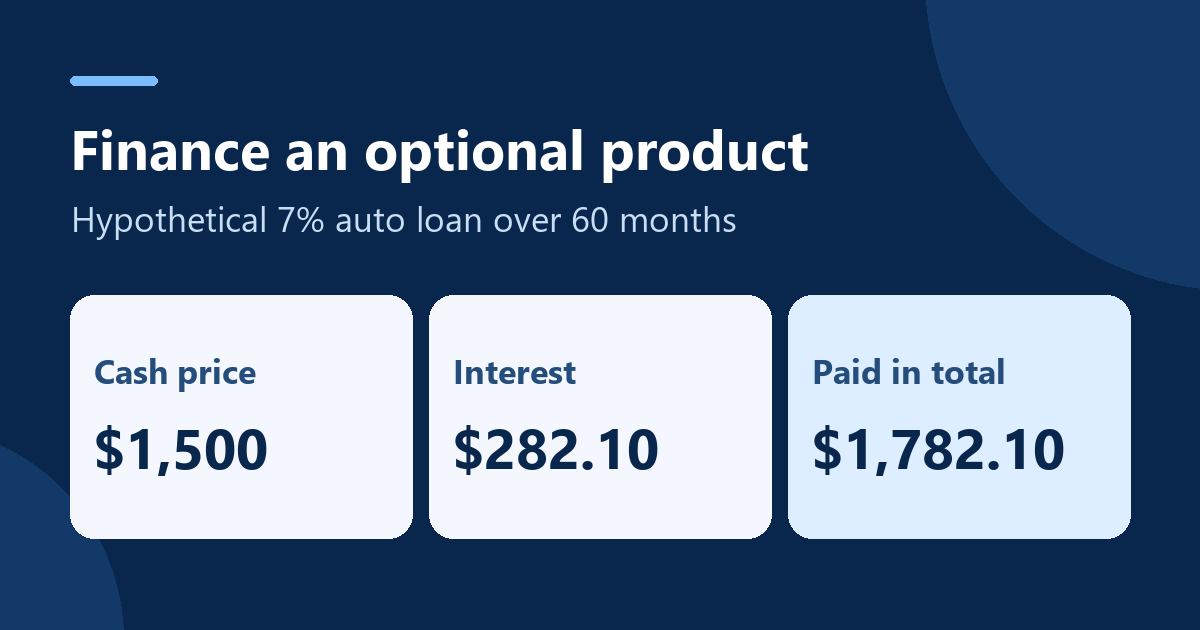
An add-on described as “about $30 more a month” sounds smaller than a $1,500 price. If you finance it, both numbers can mislead unless you know the term and interest rate. Ask the dealer to show each product by name and cash price, then decide what you would pay for it apart from the car.
Separate optional products from other charges
The CFPB's financing negotiation guide lists examples of optional products such as service contracts, GAP products, credit insurance, and tire and wheel protection. Separate those from taxes or registration fees set by government. Also ask the dealer to identify any mandatory dealer fees in the out-the-door price. A preinstalled package can be part of the vehicle price, but the dealer should explain whether a product is optional and what the vehicle costs if you decline it. The FTC's pricing guidance discusses misleading descriptions of optional items and required charges.
| Product | Check before agreeing |
|---|---|
| Vehicle service contract | What repairs are covered, what is excluded, and does it overlap with the manufacturer's warranty? |
| GAP insurance or waiver | How is the eligible loan balance calculated, and are there limits on negative equity, deductibles or other charges? |
| Tire and wheel protection | Which damage qualifies, how many claims are covered, and are repair and replacement capped? |
| Credit insurance | What event triggers payment, who gets paid, and when does coverage stop? |
Get the actual contract before deciding. A sales summary can omit a deductible, limit, eligible provider or exclusion. For a service contract, compare the period of coverage with how long you expect to keep the car and whether the manufacturer's warranty would pay for the same failure. For GAP, ask your insurer or lender whether coverage is available separately and compare the terms, not only the price.
See the financed cost in dollars
Suppose the car deal requires financing $24,000, and the dealer offers a $1,500 product. At an illustrative fixed 7% annual interest rate over 60 months, with equal monthly payments and no other charges, borrowing $24,000 costs $475.23 per month and $28,513.73 in total. Borrowing $25,500 costs $504.93 per month and $30,295.83 in total. The monthly increase is roughly $29.70. The total increase is about $1,782.10, including $282.10 in interest on the product. That is why the financing line and cash price tell different parts of the story. Repeat the comparison with the loan calculator and the rate from your quote.
Ask for one itemized quote with the products you selected and one without those still under consideration. Keep the rate, term, vehicle and down payment equal. Review both versions' total of payments. If the dealer says the rate or approval depends on an add-on, ask it to show that requirement in the lender's written terms and check directly with the lender using verified contact information. The CFPB explains that common products such as extended warranties and GAP are generally optional.
If you find a charge after signing
Choose a dollar limit based on what the product might cover. For a service contract, read the claims procedure, deductible per visit or repair, coverage limits and list of excluded parts. Check whether the contract requires advance authorization or restricts the repair shop. A long coverage period is less valuable if it begins immediately and overlaps with a warranty you already have. Ask what happens if you sell the car before coverage ends and whether transfer or cancellation involves a fee.
For a GAP product, compare the insurance settlement and remaining eligible loan balance in a sample total loss. If the settlement were $19,000 and the balance $22,000, the difference would be $3,000 before the particular agreement's limits and exclusions. A contract may exclude part of a past-due balance, rolled-in debt or other charges. Ask the provider to identify exclusions in writing and confirm whether there is a separate claim deadline. Check the lender's loan balance and your insurer's coverage before choosing between the dealer product and an alternative.
Look for the add-on contract, who administers it, how to cancel, and how a refund is calculated. Ask the dealer or administrator for written instructions. If the product was financed, check whether any refund is credited to loan principal and whether it changes the scheduled payment. A principal credit often shortens the balance payoff or lowers what is owed without automatically lowering your regular installment. Keep making payments while the cancellation is processed. Save the request, confirmation and statement that shows where the refund went.
If you see a product you did not agree to, compare the buyer's order, sales contract and finance disclosure. Raise the issue with the dealer and lender in writing and consider the FTC or your state consumer protection office if it remains unresolved. For the wider contract review, see how to compare auto loan terms and how financing extras can affect your equity.
The useful decision is whether you would buy the specific coverage for its full financed cost. If you cannot get a written price, know what it covers, or remove it from the payment for comparison, pause before agreeing to that line on the contract.