
Personal Loans
APR and interest rate measure different costs
A lender offers 11% and another offers 12%. Which loan is cheaper? The answer depends on what those figures represent and how much money reaches you after fees. One quote may be an interest rate, while the other is the annual percentage rate. The distinction changes how you estimate the payment and how you compare the price.
Use the interest rate for payment math and APR for comparison
The interest rate is the rate applied to the principal. In a fixed-rate, fully amortizing loan, your payment is based on the principal, rate and number of scheduled payments. APR expresses the cost of credit annually, including interest and certain finance charges. It accounts for the relationship between the amount financed and the payments that are due over time. The CFPB's interest rate and APR comparison explains why these percentages may differ. They can be identical in a simple loan with no additional finance charges.
APR cannot answer every question about affordability. It does not tell you whether a specific monthly payment fits, and comparing two APRs alone can hide substantial differences in repayment length. Nor is it the sum you will pay in dollars. Compare the disclosed APR on equivalent offers and separately record the total of payments and the amount you must bring at closing. Use the contractual interest rate rather than the APR to estimate the regular payment when the rate and APR differ.
Worked example: a lower interest rate with a fee
| Quote | Gross principal | Interest rate | Monthly payment | Total paid |
|---|---|---|---|---|
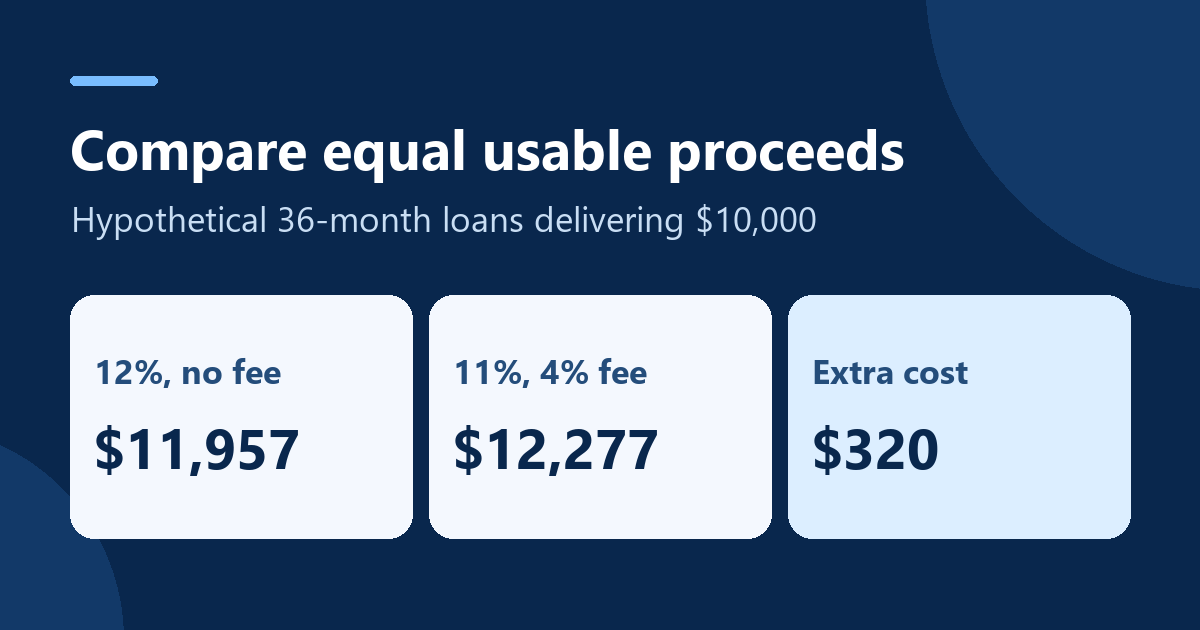
| A, no fee | $10,000.00 | 12.00% | $332.14 | $11,957.15 |
| B, 4% fee withheld | $10,416.67 | 11.00% | $341.03 | $12,277.02 |
These are illustrative fixed-rate loans with equal monthly payments, no other fees and no missed payments. Loan B needs about $10,416.67 of gross principal because the lender withholds about $416.67, leaving $10,000. Its total scheduled payments are about $319.87 higher, despite its lower interest rate. Under evenly spaced monthly payments, the cash flows imply an annualized rate of about 13.85% for loan B. Actual disclosed APR may use applicable rules for dates, timing and rounding. Loan A's cash flows imply 12% under these assumptions.
If both lenders had instead quoted $10,000 of face principal, loan B would have shown a payment of about $327.39 and funded only about $9,600. Comparing that lower monthly number with loan A would conceal the $400 funding gap. The origination fee guide shows how to adjust for a fee withheld at funding.
What the disclosure can tell you that APR alone cannot
Read the number and size of payments, the finance charge and the total of payments. Look for a different final payment, a date-based payoff calculation or costs that apply only when an event occurs. A late fee, for example, is not part of the on-time payment schedule you are using to compare a loan. Ask which fee has been included in APR and what must be paid separately. Regulation Z's closed-end disclosures spell out several of these terms. For car financing, the CFPB's auto loan disclosure guide explains where to find them in the dealer's paperwork.
A rate can be fixed or variable. The schedule for a fixed-rate loan is usually easier to compare if you pay on time. For a variable rate, ask what benchmark changes the rate, how often it can reset, and how the payment changes afterward. If a fixed-rate offer includes a discount conditioned on automatic payments, separately ask whether losing eligibility could change the schedule. Never assume an advertised maximum term or minimum APR applies to your offer.
A quick worksheet for two offers
Add a column for the date you might pay off the loan. For each quote, add any separate fees already paid, installments made by that date and the lender's estimated payoff. Then subtract what you actually received. Keep the calculation separate from the scheduled cost. A quote with an up-front fee can cost more over a short holding period even if interest accumulates more slowly. If you are unlikely to pay early, the full payment schedule carries more weight.
Use the published APR alongside the signed payment schedule if an offer has irregular installments, a different first payment date, or a special final payment. A monthly loan calculator assumes regular periods and equal installments. It is useful for checking the direction and size of a change, but you should confirm any mismatch with the lender before signing. Ask it to explain the cash flows behind the amount financed and the finance charge. A corrected quote gives you figures you can compare under the same assumptions.
- Write the dollar amount you need to receive and a repayment term you can compare.
- Have both lenders confirm the gross principal, net proceeds and up-front charges.
- Compare disclosed APRs and compare total dollars paid under the same term.
- Estimate each payment with the contractual rate using the fixed-rate calculator, then check it against the lender's schedule.
- Review variable-rate or discount rules, payoff terms and the effect of missing a payment before signing.
If a quote looks inconsistent, ask the lender to show how the net proceeds and payment schedule produce the disclosure. A slight rounding difference is different from an extra product or a shortened funding amount. The loan that meets your actual cash need at the lowest reasonable total cost can only be identified once you compare the same dollars on both sides.