
Personal Loans
How an origination fee changes the cash you receive
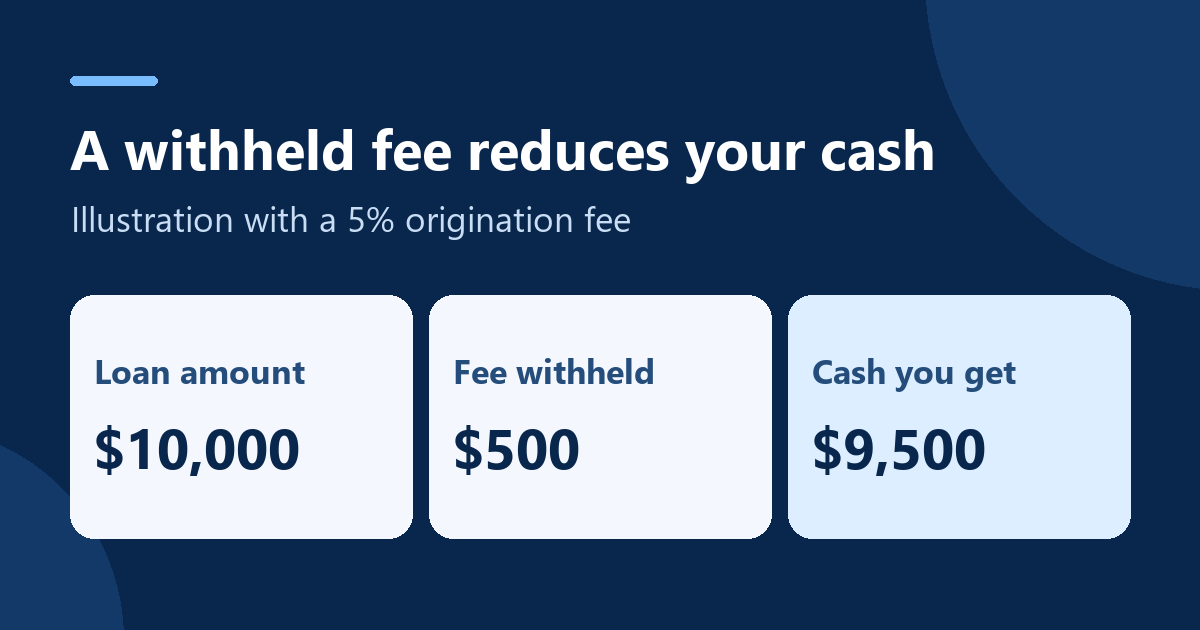
You sign for $10,000 and receive $9,500. Your monthly payments still repay $10,000 plus interest. That is what a fee deducted from the proceeds can do. The most useful question about an origination fee is how it changes the cash you receive and the amount you repay.
Find where the fee appears
An origination fee is an amount a lender charges to make a loan. It may be a flat amount, a percentage of the balance or a charge that varies by offer. The CFPB's guide to personal installment loan fees distinguishes origination fees from documentation charges, optional insurance and penalties that may apply later. Ask the lender for an itemized quote showing the amount of each fee, whether it is mandatory and when it is collected.
| Treatment | Cash available for your expense | Balance you repay |
|---|---|---|
| Fee deducted from a $10,000 loan | $9,500 | $10,000 plus interest |
| Fee added on top of $10,000 in proceeds | $10,000 | $10,500 plus interest |
| Fee paid separately at funding | $10,000, with $500 paid from your other funds | $10,000 plus interest |
The numbers assume the lender actually offers each fee treatment. Some lenders use only one. The same fee can change how much cash is available today or how much principal accrues interest. If part of your loan is going straight to a creditor, confirm the amount that creditor will receive. An origination fee that leaves an old balance partly unpaid may leave you making two payments.
Read the disclosure from the cash flow back
Say a lender withholds a 5% fee from a $10,000 loan and charges a fixed annual interest rate of 12% for 36 months. Using monthly amortization, no other fees and payments made on time, the payment is about $332.14 and the total repaid is $11,957.15. Because you received $9,500, the difference between what you receive and what you repay is $2,457.15. That includes roughly $1,957.15 of interest and the $500 fee. A fee can increase the cost without changing the payment printed next to the underlying interest rate.
If you need $10,000 in usable cash with the same percentage withheld, divide the cash target by 0.95. You would need approximately $10,526.32 of gross principal, before the lender's limits and rounding rules. At the same rate and term, the payment becomes about $349.62. Compare that with another lender's payment on a loan that delivers the same $10,000. If you only compare two quotes both labeled “$10,000 loan,” you may be comparing different amounts of usable money.
Look separately at the annual percentage rate (APR), the amount financed and the total of payments. Under Regulation Z's closed-end disclosure rules, amount financed has a specific definition. It can differ from the face amount of the loan, including when certain finance charges are prepaid. Follow the disclosure and verify the actual deposit, rather than assuming every figure called “amount” refers to the same thing. Our guide to APR and interest explains the difference in one side-by-side comparison.
Account for fees when you expect to repay early
A loan with no prepayment penalty may still have an origination fee that was charged up front. Paying early can reduce future interest but may not return the fee. Ask whether any part is refundable and compare the cost over your own expected payoff schedule. If you expect a bonus or another source of funds within six months, a high up-front fee can matter more than a modest reduction in the annual rate. Ask for a payoff estimate for each realistic date so you have more than one scenario.
Check whether insurance or other products are optional before including them in the amount financed. A payment screen that shows only the final monthly number may conceal a change in principal. Request a version without optional products and recalculate the payment using the fixed-rate calculator. The calculator models interest on the amount you enter. A fee paid from separate funds needs to be added separately when comparing your out-of-pocket cost.
To compare offers you expect to repay early, gather the same four numbers from both lenders: usable proceeds, any separate cash fee, installments you will have paid by the target date, and the payoff quote for that date. Add the fee, installments and payoff, then subtract the usable proceeds. If a fee was withheld, it is already reflected in the smaller proceeds. Adding it again would double-count it. If a fee was financed, that charge is already represented in the payments or payoff balance. Confirm how the lender calculates interest between your last payment and the payoff date.
Check an on-time payoff and a fallback date. If the expected windfall is delayed, a loan that is cheapest at six months may cost more when carried to the end. A comparison using both dates helps you see how much the decision depends on paying early. If a lender says the fee can be refunded, ask what triggers the refund and where it will appear when the account closes.
Know which fee requests are a warning sign
A fee clearly disclosed as part of a genuine loan differs from a stranger promising guaranteed approval in exchange for money sent now. The FTC warns about advance-fee loan scams. Verify the lender through its official website or a number you locate independently. Do not send money by gift card, wire transfer or similar methods because a caller says it will unlock a loan.
Before accepting a quote, record the cash you can actually use, the fees and their timing, the monthly payment and the total repayment. Compare lenders on the same cash amount and term. That short list makes a fee visible whether the lender collects it up front, deducts it or adds it to the balance.