
Personal Loans
Five numbers to check in a personal loan quote
A personal loan quote is useful when you can tell what cash you will receive, what you will owe each month and what could change between the quote and signing. Save a copy before the offer expires. If the numbers shift later, you will have a record of what you were comparing.
Set the amount and repayment window first
Write down the amount the expense actually requires and when you need to use the funds. A quote for more than you need can make a monthly payment look normal while leaving you paying interest on extra borrowing. For debt consolidation, collect the current payoff amounts and deadlines for each account. For a one-time expense, check whether paying part in cash or asking for a shorter payment plan would reduce how much you need to borrow.
Decide what monthly payment you can cover after essential expenses in an ordinary month and in a month with an unusually large bill. A lender may approve an amount that exceeds what you want to carry. The CFPB describes personal installment loans as loans delivered at the beginning and paid back in scheduled installments. That schedule matters once you sign, even if your budget changes.
Get the same fields from every lender
| Ask for | Why it matters |
|---|---|
| Gross principal and net proceeds | Shows whether a withheld fee reduces available cash. |
| Interest rate, APR and total of payments | Separates payment math, annualized pricing and total dollars. |
| Term, first due date and payment schedule | Reveals how much flexibility you have in your first month and how long you are committed. |
| Fees, required products and discounts | Lets you reprice the loan if you decline an add-on or lose a discount. |
| Early payoff and late-payment terms | Explains what changes if you pay early or fall behind. |
| Quote expiration and funding conditions | Shows how long you can compare and what must happen before you receive funds. |
Ask for the final disclosure and the scheduled payment amounts in writing. If a lender can only show a range at first, save the range as a preliminary screen and compare again once you have a specific offer. Read our guides to origination fees and APR versus interest before deciding which figure to use.
Compare the fee as well as the payment
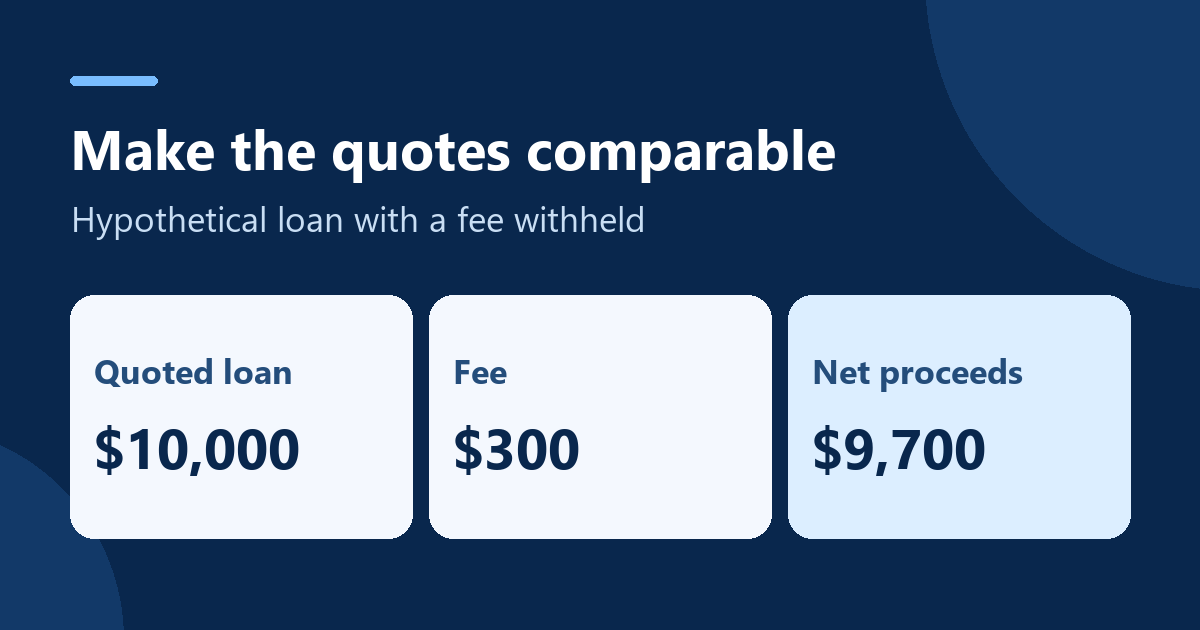
Suppose quote A shows $10,000 at 11% for 48 months with a $300 fee withheld, while quote B offers $10,000 at 12% for 48 months with no fee. With fixed monthly amortization and no other fees, quote A would pay out $9,700 and cost about $258.46 a month. Quote B would deliver $10,000 and cost about $263.34 a month. The lower payment saves about $4.88 per month on the face amounts. It also leaves you $300 short if the expense requires a full $10,000. Ask A for a revised offer at the same usable proceeds before calling it cheaper. These rates and fees are hypothetical.
Use the fixed-rate calculator for a rough payment check. Enter the amount that actually accrues interest. A separate fee is additional cash out of pocket. The CFPB notes that charges can include origination fees, documentation fees and other costs. Ask whether any listed insurance is optional, and compare the quote with and without it.
In the example, a lender that always withholds 3% would need to lend about $10,309.28 to deliver $10,000. At the same 11% rate and term, revised quote A costs about $266.45 per month and $12,789.54 in total. Quote B costs about $263.34 per month and $12,640.24 in total. Once the proceeds match, the loan with the higher interest rate saves about $149.30 over four years. Actual pricing can change at a different loan amount, so confirm the revised rate and fees in writing.
Find out when the lender will check your credit
Some lenders use a soft inquiry to show preliminary options. A full application typically involves a hard inquiry. Ask the lender before you proceed and read the disclosure in the form itself. The CFPB explains when lenders commonly access credit reports. Do not assume that a rate-shopping rule for auto loans applies to personal loans. Save your preliminary estimates and move to full applications only when needed.
Share sensitive details only through a lender channel you verified yourself. A message promising guaranteed approval for a fee paid first should send you back to the lender's official site, not to the sender's payment link. The FTC explains advance-fee loan scams and the steps to take if you encounter one.
Review the signed version against the quote
Check what has to happen before funds are released. An offer may depend on income verification, identification, an eligible bank account or up-to-date creditor information. Ask when the lender starts its funding clock and whether it counts business days. If you need funds by a firm date, find out what happens if verification runs late and whether an application can be withdrawn before you accept the agreement. Plan the old payment schedules around confirmed receipts, rather than an estimated deposit date.
Also test any discount in dollars. Ask for the payment both with and without autopay or another condition and check whether the discount is built into the displayed rate. Find out whether you can move a due date and what happens to a pending debit if you also pay manually. A small discount is easier to assess when you know the debit fits your regular pay schedule.
Before authorizing funding, check the loan amount, final APR, length, fee treatment, first due date and where the money will go. If the lender pays another creditor directly, keep a record and continue required payments until receipt is confirmed. If the lender requires automatic payments for a discount, understand how stopping them affects the schedule. Keep the signed agreement where you can reach it later. A complete quote should give you enough information to run these checks before the first payment is due.