
Credit Cards
What a 0% balance transfer really costs
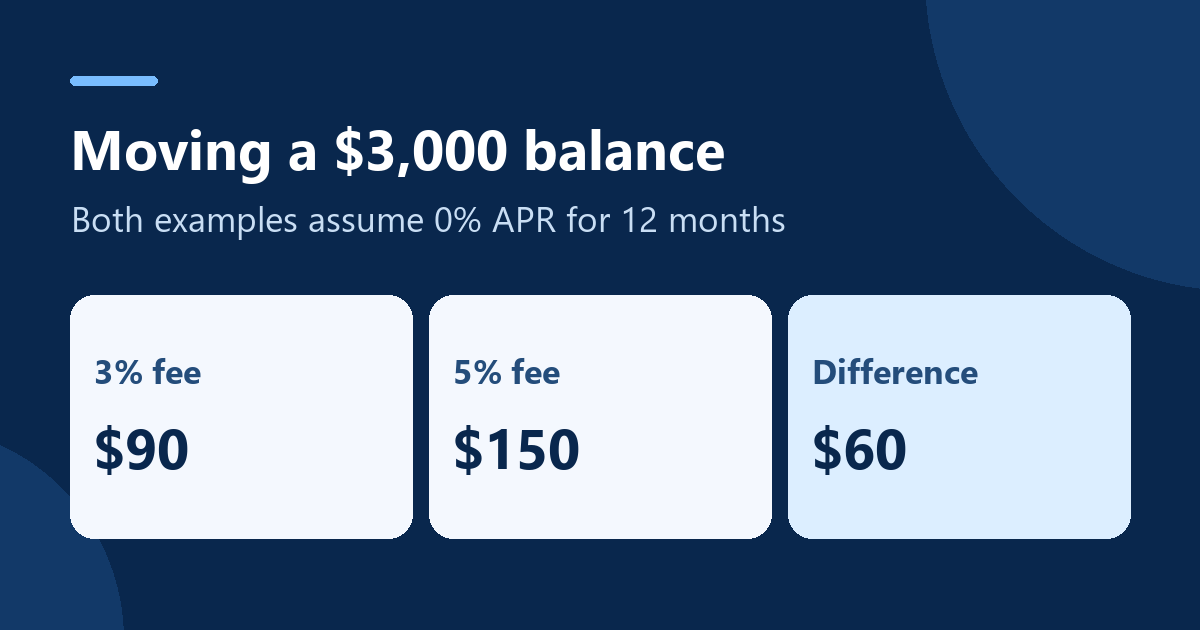
A 0% balance transfer can save hundreds of dollars, or it can leave you with a new fee and a balance that still costs interest when the offer ends. The decision starts with three numbers: the fee, the months you can actually use, and the amount you can pay every month without borrowing again.
Find the full cost of moving the balance
Open the offer's pricing disclosure and find both the percentage fee and any minimum dollar fee. The CFPB confirms that an issuer can charge a transfer fee on a zero-interest offer. The fee can be added to your balance. Confirm whether it receives the promotional APR and whether the transfer plus the fee must fit under a separate transfer limit. Also check whether the issuer limits transfers from accounts within its own group.
| Offer terms | Up-front fee | Starting balance | Payment to finish in 12 months |
|---|---|---|---|
| 0% with 3% fee | $90 | $3,090 | $257.50 |
| 0% with 5% fee | $150 | $3,150 | $262.50 |
The table assumes both offers last at least 12 months, the fee receives the promotional APR, no purchases or other fees are added, and each payment posts on time. If the second offer gives you more months, the extra $60 may be worthwhile if you need the breathing room. If you can finish in the same 12 months either way, the extra fee buys nothing in this example. A minimum fee matters most on small transfers. A hypothetical fee of 3% or $10, whichever is greater, would cost $10 on a $200 transfer, equivalent to 5% of the amount moved.
Compare with keeping the old card
Estimate both paths over the same payoff horizon. The first path is the interest you expect to pay if you leave the debt where it is. The second includes the fee, any interest outside the promotion and any charges on purchases you put on the new card. The faster you can clear the original balance, the less interest there is for the transfer to save.
For example, assume a $3,000 existing balance, a hypothetical 24% annual rate, monthly interest approximated at 2%, fixed payments and no new purchases. Twelve equal payments to retire that balance would be about $283.68 per month, or roughly $404 in total interest. In the 3% transfer scenario above, the fee is $90, so the illustrated savings are about $314. If you could pay the original card in two months instead, the same model puts total interest at about $90.30. A $90 transfer fee would leave almost no savings before considering timing or any additional charge. This is a comparison model. Your card may calculate interest daily, as explained in our daily interest guide.
Keep the two dates separate
The transfer request deadline and the promotional expiration date may differ. Write down both. Find out when the promotional clock starts, since it may start at account opening rather than when the transfer clears. Keep paying the old card until its issuer confirms receipt. Check for interest that accrued between its previous statement and payoff. On the new account, maintain at least the minimum payment every month, and set a separate target that clears the transfer before the promotion ends.
If there are 15 months available but you target 14 payments, a $3,090 balance takes about $220.71 per month. If you can only afford $180, 14 payments would leave $570. Before accepting the offer, find the post-promotion APR and decide how you would pay the remaining balance. Making the required minimum on time can protect payment standing, but it does not move the promotional deadline.
Watch for purchase interest and deferred interest
A 0% rate for the transfer alone does not cover purchases. The CFPB explains how carrying a transfer can affect the purchase grace period. Check how to keep or regain that grace period under your agreement. An easy way to separate the two jobs is to reserve one account for the repayment plan and use a different payment method for everyday purchases when your budget allows.
A standard introductory 0% APR generally charges interest going forward on a balance still outstanding after the promotion. Deferred interest can charge interest accrued during the promotional period if you do not satisfy the payoff terms. Look for phrases such as “if paid in full,” and check what happens to amounts paid above the minimum when an account holds multiple balances. The CFPB's comparison of promotional offers illustrates the distinction. For a purchase example using dates, see how grace periods work.
Plan for a partial transfer or an expense you did not expect
You may be approved for less than you wanted to move. If you have $3,000 owed and can transfer only $2,000, a 3% fee would add $60 to the new balance in this hypothetical offer. For a 12-payment plan, target about $171.67 on the new card before rounding the last payment. You would still need a payoff plan and timely minimum payments for the $1,000 remaining on the old card. Run your budget with both obligations before authorizing the partial transfer.
Make a fallback plan for a month when you can pay less. Skipping $100 of your target this month means adding $100 to future payments or leaving a balance at expiration. Spread the catch-up over the months you still have. Keep a copy of the offer and review the issuer's statement for the promotional balance as the end date approaches. If the transfer fee or timing differs from the written disclosure, contact the issuer early, while you still have time to change your payment plan.
Make the decision in dollars
Get the fee and expiration date in writing, compare the savings against the old card under the same payment plan, and leave time to confirm the last payment cleared. If the numbers only work with a larger monthly payment than you can reliably make, the advertised rate does not solve the problem. If the fee is clearly below the interest you would otherwise pay and your payoff plan fits, the transfer has a measurable benefit.