
Credit Cards
How credit card interest can add up daily
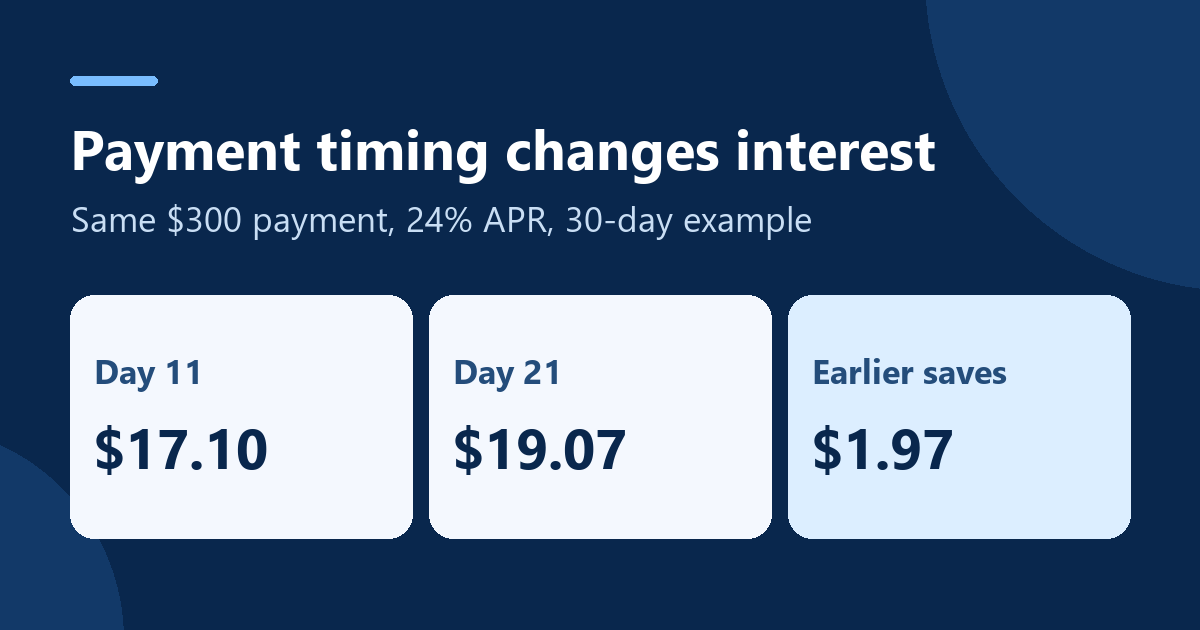
A $300 payment made ten days earlier can save interest even when you finish the billing cycle with the same balance before interest is added. The difference is the number of days that $300 was still on the card. If you carry credit card debt, that daily arithmetic matters more than the date the interest charge finally appears. If you qualify for a purchase grace period and pay in full on time, the same card can charge no interest on eligible purchases.
Start with the APR for the balance you owe
The annual percentage rate, or APR, expresses the interest rate on a credit card balance as an annual percentage. Your account may have separate rates for purchases, cash advances and balance transfers. Check the statement section that lists interest charges. Match each rate to its balance before trying to explain the total. A 0% transfer and a 24% purchase balance can sit on the same statement. The Consumer Financial Protection Bureau explains how issuers disclose the separate balances and rates.
Many issuers use a daily periodic rate. Under an agreement that divides by 365, a 24% APR produces a daily rate of 0.24 ÷ 365, or about 0.06575% per day. A $1,000 balance subject to that rate costs roughly 66 cents for one day before considering compounding. Read your own agreement for the denominator, rounding, posting rules and whether accrued interest is included in a later day's balance. Those details matter if you are trying to match the issuer's calculation to the penny.
How average daily balance works
Add the balance for every day of the billing cycle and divide by the number of days. A purchase or payment changes the daily balance starting on the day the issuer includes it. When the issuer uses a single rate throughout the cycle and does not add daily interest back into this example's balances, you can estimate interest by multiplying the average daily balance by the daily rate and the days in the cycle. Calculating interest separately on each day gives the same result under those assumptions.
| Days | What changed | Daily balance | Balance × days |
|---|---|---|---|
| 1–10 | Opening balance | $1,000 | $10,000 |
| 11–20 | $300 payment credited on day 11 | $700 | $7,000 |
| 21–30 | $200 purchase included on day 21 | $900 | $9,000 |
The average is $26,000 ÷ 30, or $866.67. Using the unrounded average, estimated interest is $866.666… × 0.24 ÷ 365 × 30 = $17.10. This example assumes no grace period, fees, rate changes or daily compounding and that payments and purchases affect the stated day. If the $300 payment were credited on day 21 instead, the average balance would be $966.67 and the interest approximately $19.07. The ending balance is $900 in both cases. Paying earlier saves approximately $1.97.
Do not substitute the ending balance for the average. Also check whether a credit, return or scheduled payment was actually posted. Billing cycles are not always 30 days. A change in APR during the cycle, a separate promotional balance or an issuer method that includes accrued interest in daily balances can change the result.
When the purchase grace period applies
The grace period is the time between the end of a billing cycle and the payment due date. If the agreement offers a purchase grace period and you meet its terms, paying the full statement balance on time generally avoids interest on eligible purchases. The statement balance is the amount captured when the cycle closed. The current balance can include newer purchases. A minimum payment generally satisfies the payment requirement for that month but does not preserve a purchase grace period by itself. Check the CFPB's grace-period guide and our statement-date walkthrough.
Once you carry a balance, new purchases may accrue interest from their transaction date. Restoring the grace period can take more than one billing cycle, depending on the agreement. Even after you pay the statement balance, interest may have accrued between the statement closing date and the day your payment posted. That is often called trailing or residual interest. If you want to pay off a card that has been accruing interest, ask the issuer what amount is needed as of your intended payment date and check the next statement for a residual charge.
Purchases, cash advances and transfers behave differently
A cash advance commonly starts accruing interest immediately and may carry both a separate APR and a transaction fee. For illustration, a $300 advance with a 5% fee costs $15 up front. At a hypothetical 29.99% APR for 14 days, the interest on the $300 is about $3.45 under simple daily calculation. That is approximately $18.45 in fees and interest before any ATM charge or interest on the fee itself. The starting date and what goes into the interest-bearing balance come from your agreement.
A balance transfer can have a promotional APR and a fee. At an assumed 3% fee, transferring $3,000 adds $90. Paying $3,090 over 15 equal months takes $206 per month if the full amount truly bears 0% throughout and there are no other charges. Read whether the promotion covers only the transferred balance. New purchases can have a different rate and may lose their grace period while you carry the transfer. A true introductory 0% APR and a deferred-interest offer work differently. Read the deadline and whether interest can be charged retroactively in our balance transfer guide.
What minimum payments do and where extra money goes
Say your balance is $2,000, your APR is 24%, and a simplified month costs 2% in interest. A hypothetical $60 payment would cover roughly $40 of interest and reduce principal by about $20. The actual interest depends on the daily calculation and the minimum changes according to your agreement. Your statement's minimum-payment warning generally estimates the payoff time and cost if you pay only the minimum and add nothing to the balance. Some statements also show a 36-month repayment estimate. The disclosure rules and exceptions appear in Regulation Z's periodic statement rule.
Suppose the minimum is $40 and you pay $140. Generally, the federal payment allocation rule sends the $100 above the minimum to the highest-APR balance first. The issuer generally determines where the required $40 goes. Special rules apply to some balances, including deferred-interest balances near their promotion deadline. Read the next statement to confirm how your payment was applied.
Build a plan around the days you pay interest
- If you have a purchase grace period: Plan to pay the full statement balance by the due date. Set alerts that leave time to check your bank balance and payment posting.
- If interest is already accruing: Pay at least the required minimum on time and consider sending money earlier in the cycle when your budget allows. Avoid adding purchases while paying down the balance if you can cover them another way.
- If you have multiple balances: List each APR, promotional expiration and fee. Inspect what the statement says about the minimum and excess payment allocation.
- If the balance is hard to manage: Contact the issuer before missing a payment and ask whether it offers a hardship arrangement. Compare written terms and any fees before moving debt.
The quickest way to check the next statement is to mark the balance subject to each APR, the days it was outstanding, and the date each payment posted. That separates avoidable interest from charges you still need to verify. The smallest useful change can be as simple as sending the same payment earlier when there is no grace period.