
Credit Cards
Capital One Quicksilver offers flat-rate cash back
Flat cash back can make a credit card easy to use. It can also make the costs easy to overlook. With Capital One Quicksilver, the rewards math takes seconds. The more consequential questions are which Quicksilver offer you are looking at, whether you will carry a balance and whether a promotional transfer will be repaid on time.
Identify the exact offer before comparing
On November 25, 2026, the Capital One Quicksilver Cash Rewards product page showed 1.5% cash back on eligible purchases, a $0 annual fee and no foreign transaction fee. The offer shown on that page included a one-time $200 bonus after $500 in purchases within three months of account opening, along with a 15-month introductory APR on purchases and balance transfers. Capital One offers different products under the Quicksilver name. Confirm the exact card and read the attached disclosure, since the APR, introductory offer, bonus or fees can vary by version, application channel and date.
Capital One provides an eligibility check advertised as having no impact on credit scores. Checking eligibility is a separate step from applying for a credit card. Confirm when the issuer asks permission for a formal credit check, and avoid submitting multiple applications because you believe a preliminary result guarantees approval. Save a copy of the offer and check that the final APR and fees match the version you intended to apply for.
Translate 1.5% into a dollar figure
| Eligible purchases each month | Cash back per month | Cash back over 12 months |
|---|---|---|
| $400 | $6.00 | $72.00 |
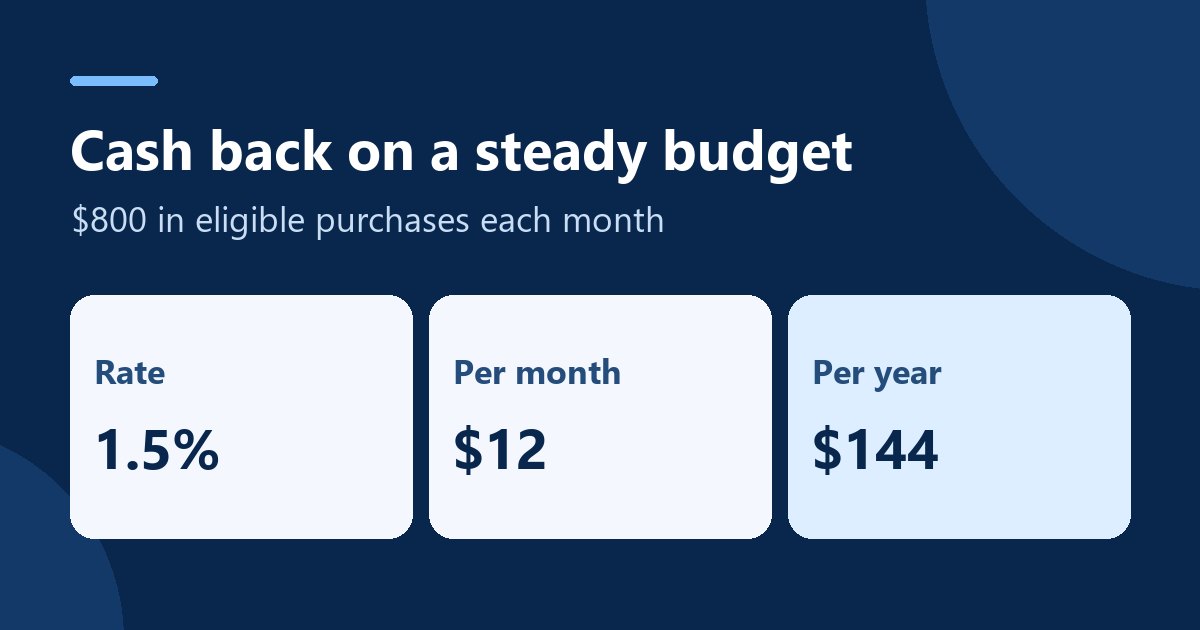
| $800 | $12.00 | $144.00 |
| $1,200 | $18.00 | $216.00 |
The figures assume all purchases qualify, there are no refunds, and you repeat the spending amount each month. If you earn the bonus, count it in the year it posts and exclude it when comparing what the card will earn in a normal year. A $200 introductory bonus is valuable only after accounting for what you spend to qualify. Purchasing a $95 item you did not need to reach the threshold uses up nearly half the bonus. A cash advance or balance transfer should never be assumed to count toward eligible purchase spending.
Compare higher category rates with the way you actually shop. If your spending is spread across bills, groceries and miscellaneous expenses, flat-rate cash back requires less tracking. If a large portion qualifies for bonus categories, a card such as Chase Freedom Unlimited may earn more. Match the categories each issuer recognizes to three typical months of your own transactions. Then subtract annual fees if any and count only benefits you would actually use.
Use the foreign transaction feature carefully
A purchase can be charged in local currency and converted by the card network, or a merchant may offer to convert it into dollars at checkout. Capital One's no-foreign-transaction-fee feature refers to the issuer's fee under the terms of this card. It does not make a merchant's exchange rate attractive. If you see a choice, compare the displayed total and rate before accepting. A simple illustration: if a different card charged a 3% foreign transaction fee on $600 of eligible foreign purchases, the fee would be $18. That calculation says nothing about the exchange rate or other merchant charges.
A card accepted overseas is also a different tool from a cash withdrawal. If you need cash, check the issuer's cash-advance APR, the transaction fee and any ATM charge before using the credit card. Cash advances often begin accruing interest immediately. The CFPB glossary for credit cards explains how these transactions differ from ordinary purchases.
Put the introductory APR on a calendar
For a purchase promotion, identify when the introductory period expires and how much to pay each month so the balance is gone by then. A hypothetical $1,500 purchase paid in 12 equal installments costs $125 per month at 0%, assuming there are no fees or new transactions. Schedule a final review before the promotional end date so that a payment credited later than expected does not leave a balance at the regular APR. Pay at least the required minimum by each due date while following your own accelerated schedule.
For a balance transfer, read the applicable fee and deadline in the offer. A $2,400 transfer with a hypothetical 4% fee starts at $2,496. Fourteen payments of roughly $178.29 would retire that amount if it remains at true 0% for the entire period. The 4% assumption is an illustration, not a Quicksilver fee quote. Keep paying the original issuer until the transfer is posted. Check whether a carried transfer affects the grace period on new purchases. Read our balance transfer cost guide before deciding to move a balance.
At a hypothetical 24% purchase APR, $800 held for 30 days costs about $15.78 using simple daily interest on a 365-day basis. That exceeds the $12 reward on $800 of eligible purchases. The reward may post visibly long before the financing cost appears on a statement. See how to estimate your interest and compare with your own disclosed APR.
Check how you will redeem the rewards
Look at the available redemption choices and how much cash back each will use. For example, a $25 statement credit and a $25 cash redemption both have a face value of $25, but they affect your bank balance and card balance differently. Confirm when each redemption posts. A pending statement credit may not satisfy the minimum due, so pay according to the issuer's instructions even if you expect the credit before the due date.
Also compare a flat-rate card with the card you already own before opening another account. If your existing no-fee card earns 1% on $800 of eligible monthly purchases, moving the same spending to a 1.5% card would add $4 a month, or $48 a year, assuming no fees, refunds or interest. If the existing card gives higher rewards on some of those transactions, even that $48 may overstate the difference. Review a few statements, identify purchases eligible for extra rewards and compare the incremental benefit, rather than counting all Quicksilver cash back as new savings.
Decide on your main use for the card
Flat-rate rewards are easiest to value when you typically pay the statement balance in full. In that case, compare net annual cash back based on your actual transactions and check the redemption options you would use. If you need to borrow, start with the repayment dates, fees and regular APR. A simple card can be useful for a simple spending pattern. The complexity returns the moment you carry debt past the date the offer assumed you would pay it off.