
Credit Cards
How a credit card grace period works
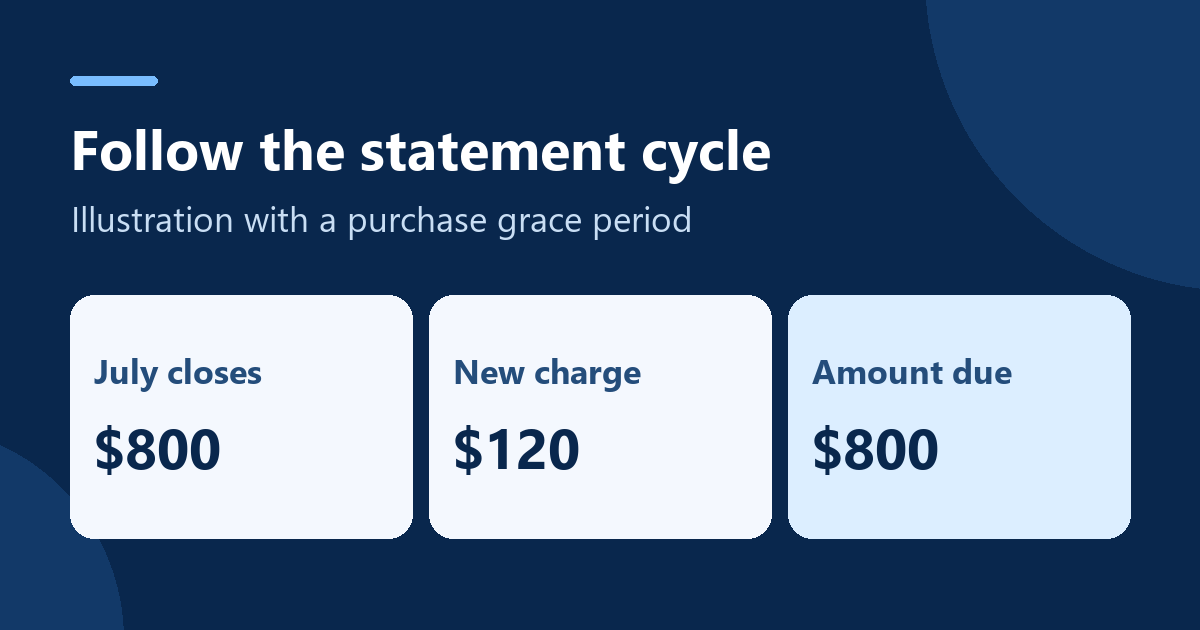
The date you buy something, the day your credit card statement closes, and the payment due date are three different dates. Knowing which balance the issuer expects by the due date can save you from paying interest on purchases without having to pay off charges that belong to the next statement.
Read the cycle before you schedule a payment
A billing cycle is the period covered by your statement. The statement balance is what the issuer recorded at the end of that period. Your current balance reflects later activity, which can include new purchases, refunds and payments. The minimum payment is the smallest amount required by the due date to meet the current payment obligation. Where a purchase grace period applies, the agreement generally requires more than the minimum to avoid interest. The CFPB's explanation of grace periods describes the interval between the end of the billing cycle and the due date.
| Date | What happens | What it means |
|---|---|---|
| July 1–31 | $800 of eligible purchases post | Assume the account qualifies for a purchase grace period. |
| July 31 | The statement closes at $800 | $800 is the statement balance. |
| August 5 | A new $120 purchase posts | The current balance can now be $920. |
| August 25 | The $800 statement balance is due | If it is paid in full on time and the grace terms are satisfied, the $120 is addressed on the next statement. |
Assume there are no earlier carried balances, fees, transfers or cash advances in that example. If you pay $800 by August 25, the $120 does not also need to be paid that day just because it is visible in the app. If you pay only $300, the remaining $500 is carried and new purchases can start accruing interest under the agreement. The amount shown in an app can be useful for budgeting, but the statement and agreement explain what triggers interest.
What changes after you carry a balance
A credit card issuer is not required to offer a grace period. Most do for eligible purchases, according to the CFPB. If you have one and fail to meet its terms, interest can accrue on the portion you carry and on new purchases from their transaction dates. Regulation Z's account-opening disclosure rules cover the need to explain grace-period conditions. Some agreements require full payments over one or more cycles to get the grace period back. Check the wording for your account instead of assuming a payment immediately resets it.
Here is a simplified example of interest after losing the grace period. A $120 purchase held for 20 days at a hypothetical 24% APR costs about $1.58 with a 365-day denominator, no compounding and no other charges. An extra $1.58 is small, but the same rule can apply to several purchases while you are also paying interest on an older balance. See the worked average-daily-balance example for how the issuer may count each day.
There can also be trailing interest. Imagine the June statement closes with interest already accruing and you pay the full amount 15 days later. Interest may have accrued in those intervening days, after the statement was calculated. Ask for the amount needed to pay off the balance on a specific date, then check the next statement. Keep payment reminders active until you verify the account is clear.
Purchases are only one type of balance
Cash advances generally start accruing interest when the transaction occurs. A balance transfer can have a different APR and may interfere with the purchase grace period even during a 0% transfer offer. The CFPB's balance transfer guidance explains that distinction. A statement may contain several buckets, and a single grace-period assumption may be wrong for two of them. If you plan to transfer a balance, use our cost and deadline checklist to separate the transfer from new spending.
Check when a payment counts as received
Scheduling a payment and having it credited are different events. Read the issuer's instructions for the accepted payment method, due-date cutoff and time zone. A bank bill-pay service may deliver a payment later than the day you initiate it. Regulation Z's payment rules address crediting and related requirements, but your statement is the best place to start for account-specific instructions. Keep confirmation records and check that the issuer credited the payment to the correct account.
Some purchases post after the date shown on your receipt. That can move a charge into the next statement, which affects which amount is due when. It does not change a cash advance into a purchase or restore a lost purchase grace period. If you made a large purchase right before closing, check both the posted charge and the next statement before updating your budget. The goal is to have the money available when the right statement comes due.
Make full payment routine when cash flow allows
Set a statement-closing alert so you see the actual amount due, and a second reminder before the due date. If you use autopay, confirm whether it pays the statement balance, the minimum or a fixed amount. Check that your bank account can cover it, and verify how any manual payment changes the scheduled draft. Returns, disputed transactions and credits do not always affect the amount due in the way you expect, so check the issuer's statement and instructions rather than reducing the payment on your own.
If you cannot pay in full, pay at least the required minimum on time if possible, plan the next extra payment around when funds arrive, and limit new charges where you can. The useful habit is to begin with your statement, then read which balances are accruing interest. That gives you a payoff date you can act on instead of relying on a balance that changes every time you open the app.