
Credit Cards
Chase Freedom Unlimited: What to know before you use the 0% offer
A card that earns $15 on $1,000 of ordinary purchases can cost more than that in a single month of interest. Chase Freedom Unlimited can be useful as a cash-back card or as a short-term financing tool, depending on how you pay. Before applying, decide which job you want the card to do and price that job all the way through.
What Chase was offering when we checked
On November 25, 2026, the Chase Freedom Unlimited product page listed no annual fee, 1.5% cash back on most eligible purchases, 3% on dining and drugstore purchases, and 5% on eligible travel booked through Chase Travel. The same page showed a $200 new-cardmember bonus after $500 in eligible purchases in the first three months from account opening. Chase showed a 0% introductory APR for 15 months from account opening on purchases and balance transfers, followed by a variable APR. The issuer's comparison page and product page can display different pricing depending on the offer or when the page was updated. Use the pricing disclosure attached to the application you actually submit.
Check the new-cardmember restriction before counting the bonus. Chase's public page excluded current cardmembers and previous cardmembers who earned a new-cardmember bonus on this card in the past 24 months. The bonus clock starts when the account opens. Cash advances, balance transfers, fees and certain cash-like transactions do not qualify as purchases. A return can also reduce qualifying spend. If your normal expenses do not reach the threshold, buying extra things solely to trigger the bonus reduces what the offer is worth.
Estimate the rewards from your own budget
| Eligible spending | Amount | Rate | Rewards |
|---|---|---|---|
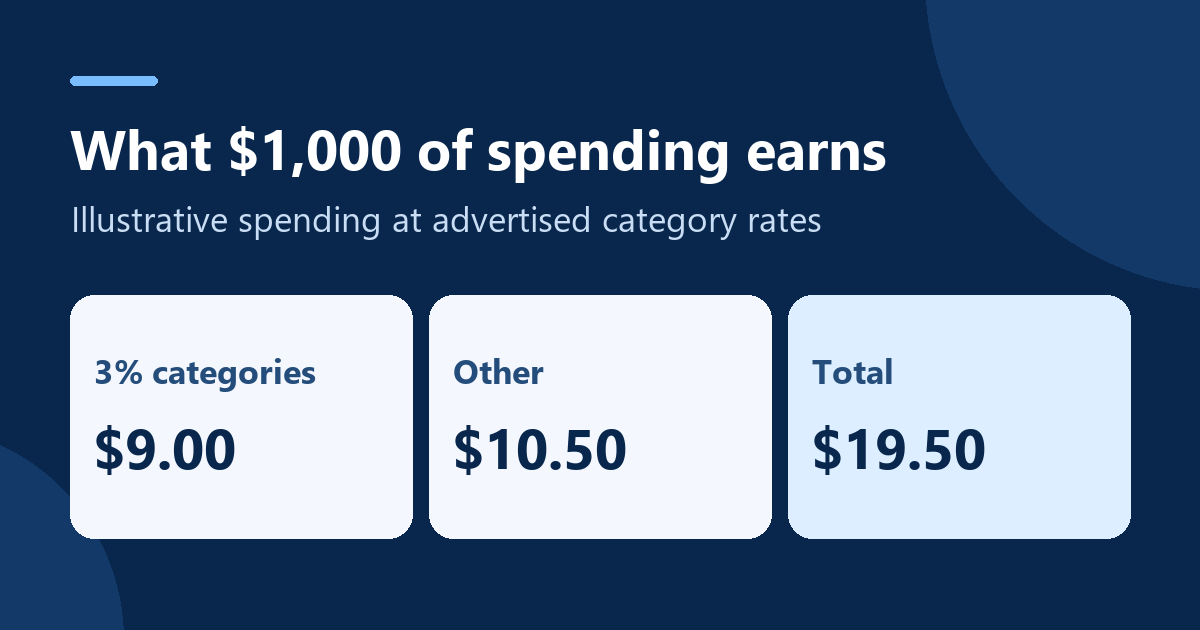
| Dining and drugstores | $300 | 3% | $9.00 |
| Other purchases | $700 | 1.5% | $10.50 |
| Total | $1,000 | 1.95% effective | $19.50 |
If the same spending repeats all year, that is $234 before any bonus, fees or interest. A flat 1.5% card would earn $180 on the same spending. The $54 difference comes entirely from the special categories. That gives you a concrete basis for deciding whether tracking categories is worth your attention. See our Quicksilver guide for how a flat-rate card handles a different spending mix.
Merchant categorization and booking method matter. A restaurant inside a hotel, for example, may be billed as part of the hotel transaction rather than coded as dining. Check how the issuer defines the purchase before budgeting for a higher reward rate. For travel, compare the portal's all-in price and refund terms with booking directly. A hypothetical $420 portal booking at 5% earns $21. A $400 direct booking at 1.5% earns $6. If cancellation terms and other benefits are identical, the net costs are $399 and $394 respectively. The higher earning rate still leaves the portal option $5 more expensive in that example.
Run the promotional payoff before moving debt
A transfer fee may be charged during the introductory period. Open the pricing disclosure and identify the fee, the deadline for moving the balance, any restrictions on balances from the same issuer and the variable APR that follows. Also check whether the approved limit can accommodate the transfer plus its fee. If you cannot move everything, make a payment plan for both accounts. The CFPB explains why a fee can apply even on a 0% transfer.
For illustration, a $4,800 transfer with an assumed 3% fee starts at $4,944. This is hypothetical and does not describe Chase's fee. At 0% with no other charges, $4,944 divided by 15 months is $329.60. Targeting 14 equal payments instead takes about $353.14 a month, leaving some room for posting delays. Keep paying the original account until the transfer posts, then reconcile both statements. For more detail, see how to test whether a transfer pays for itself.
For a new purchase under the introductory APR, draw up the same schedule before swiping. A $1,200 purchase divided across 12 payments is $100 per month under true 0% financing and no fees. That schedule only helps if you reserve $100 each month and avoid creating additional balances that push the payoff past the end date. Paying the issuer's minimum and assuming it will retire the balance by the promotional deadline is a common mistake.
Read the costs that cash back does not offset
Review the separate purchase, transfer and cash-advance APRs, and check late, transfer and foreign transaction fees in the offer's pricing table. No annual fee leaves room for other charges. A simple interest illustration shows the trade-off. A $1,000 balance carried for 30 days at an assumed 24% APR costs about $19.73 under a 365-day daily-rate calculation, with no grace period or compounding. That nearly equals the $19.50 of monthly rewards in the example, even before any fee. Read how daily credit card interest is calculated before comparing rewards against debt costs.
If you will travel internationally, compare the pricing disclosure against a card whose official terms list no foreign transaction fee. If you are considering cash advances, find another way to fund the expense if feasible. Cash advances may begin accruing interest immediately under the agreement and normally do not earn rewards. If the card will be used primarily for an existing balance, a larger net savings on interest can matter more than any ongoing reward category.
Choose a payment setting that matches the purpose
For ordinary spending, decide which account will fund the statement payment. Use statement-balance autopay only when that account will have sufficient funds, and check when a manual payment affects the automatic draft. For promotional financing, use a calendar reminder for the required minimum and a separate reminder for the amount set in your payoff plan. If you rely on an automatic fixed payment, make sure it can be adjusted if the required minimum later exceeds it.
When the account holds both a promotional transfer and a regular-rate purchase balance, a payment above the minimum is generally allocated first to the balance with the highest APR. The issuer generally controls how it allocates the minimum portion. The federal payment-allocation rule has exceptions, including for certain deferred-interest balances. Review the next statement to see where your payment went. A payment that reduced high-rate purchase debt can be a good result, but it may leave more to pay toward the transfer before the 0% deadline.
What to decide before you apply
Write down expected eligible spending, the repayment amount you can commit to, and the APR and fees available through your actual offer. If you carry no balance, compare repeatable rewards after fees, ignoring a one-time bonus when choosing a long-term card. If you need the introductory period, use the last date you can clear the balance as the decision point. A written payoff schedule can tell you whether this card fits your cash flow before a new credit line turns a one-time expense into a recurring bill.